Tesla in Congo - Exploring the Data
Introduction
Estimates by industry experts project that the electric vehicle market will pump out 340 million electric mobility units (cars, buses, etc.) between now and 2030[i]. In the same period, the global value of cobalt, lithium, and nickel for batteries is set to increase from $5 billion to an astounding $135 billion. This growth will be fueled in large part by the demand for battery-powered electric vehicles which will make up 1 in 5 of all vehicles sold and 80 percent of total battery demand by 2030. Tesla sits right at the center of the market forces that are nudging consumers from California to Berlin to Copenhagen towards an electric future. As it does this, Tesla has begun seeing record profits and, with it, close scrutiny of the global supply chain that continues to power its dizzying expansion. This brief explores a handful of data sources that link together the profit motives of Tesla and its supply chain partners with the emerging issues of human rights abuses that plague mining activities in Congo.
Children of a Lesser God: Congo’s Unending Dance with Exploitation
A recent survey of downstream players conducted by Amnesty International suggests that majority of the companies sourcing cobalt from Congo have taken little to no action on key measures meant to ameliorate ongoing abuses. Of the 27 players surveyed, 74 percent revealed, through self-disclosures no less, that they have not: initiated human rights abuse investigations; implemented policies of abuse detection; moved aggressively to cut off choke points for exploitation; taken up radical disclosure to expose violations; or started down the path of rectifying any of the harm done[ii].

Tesla, while performing better than the average company surveyed, only provided 1 response (out of 5) that was deemed adequate by Amnesty. What this data reveals is that many of the multinational companies that are operating in Congo, Tesla among the most prominent of them, have so far failed to demonstrate the level of accountability and responsible stewardship that would make their participation in Congo’s economy fruitful and just for all.
Cobalt: The Fuel Powering Tesla’s Stock Price
Before 2020, Tesla’s stock traded at an average of $55 per share[iii]. In 2020, the company’s stock price climbed above the $100 per share mark for the first time, marking the beginning of what appears to be a sustained period of bullishness for shareholders and other market speculators. In early October, the stock price sat just below $440. Tesla’s stock price, fueled by the cobalt in the car manufacturer’s vehicles, is instructive in several ways.
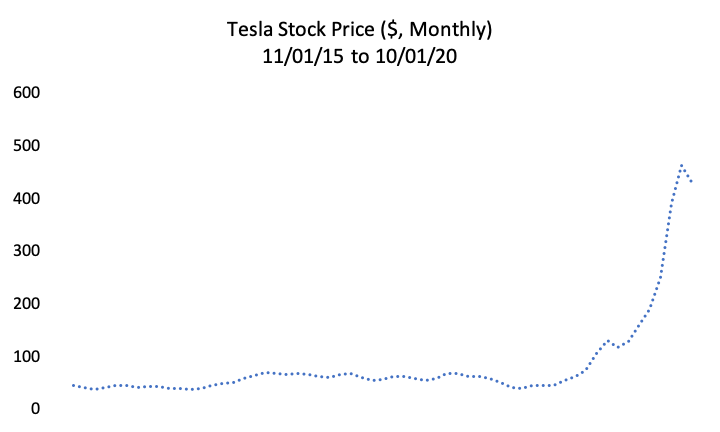
Firstly, it signals that the company has finally shed the image of chronic operational mishaps and production-related delays by churning out the kind of volumes that have long been expected of the pioneering company. Secondly, the stock price shows that both consumers and the market expect that the company, having turned a critical corner, will maintain this trend going forward. Thirdly, it gives confidence to the electric vehicle industry as a whole; basically, Tesla proving its business model is a shot in the arm for an industry that has faced doubts from many observers over the years.
Finally, and perhaps most critically, the broader trends of Tesla’s stock price are important in understanding future cobalt mining activities in Congo. This is especially so because, while the company has agreed to slow its use of cobalt in vehicle components, the sequestration process might be drawn out enough that human abuses related to cobalt mining in Congo persist. Relatedly, other electric vehicle makers might want to replicate the cost-effective growth that Tesla has experienced by relying on cobalt until they themselves are large enough to attract the type of public scrutiny that would compel them to explore other sources. Either way, the stock price is an important gauge of the direction that cobalt mining might take which, in turn, has important implications for the human rights situation in Congo.
Interconnectedness: (Not) Accepting Responsibility for the Immorality of Upstream Partners
Due to the interconnected nature of electric vehicle and global cobalt mining supply chains, it is worth looking at the motives and performance of some of the upstream players that are entangled with Tesla. Glencore, one of the world’s largest producers of cobalt, is one such example. As one of the companies that has had a history of supplying Tesla and other major technology companies with cobalt, Glencore’s performance is tied to the financial health, strategic direction, and public perception of companies like Tesla and their affiliates. The stock price of Glencore offers interesting insights into how markets have assigned fault over the human rights transgressions that both Glencore and Tesla are jointly accused of.
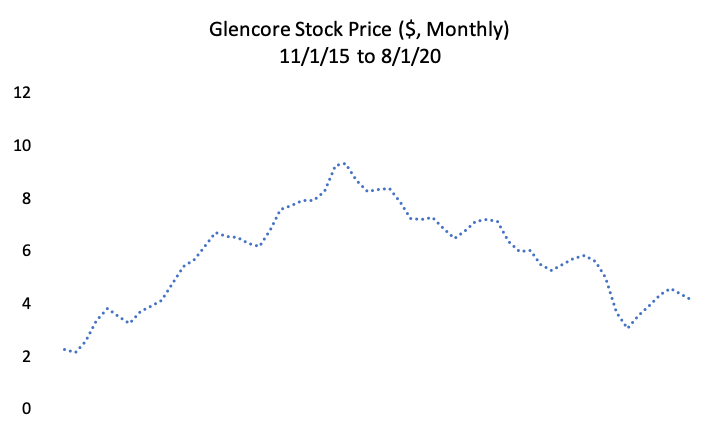
Having peaked at $10 per share, Glencore’s stock now trades at around $4[iv]. While this is double the pre-peak levels, the downward trajectory of the company’s stock speaks to some of the difficulties that the company has had to weather due to its chequered human rights record in Congo. To be sure, the company’s stock has borne the brunt of the public backlash and court disputes that have come about as its record of wanton abuse has taken centerstage. More than Tesla, Glencore’s economic prospects – the very returns its shareholders expect – have taken a hit as Tesla has emerged largely unscathed despite having aided and abetted much of the damage that the two companies are jointly accused of inflicting on communities in Congo. As if to rub salt into the wound, Tesla’s recent pronouncements about an impending switch to cobalt alternatives in their battery-making processes may have dented even further some of the remaining investor confidence in the long-term performance of Glencore’s stock.
Into the Future: Less Cobalt for the World and More Freedom for the Congolese
The recent announcement by Tesla to limit the use of cobalt in its batteries is one that is potentially far reaching. While undoubtedly not solely because of Tesla’s announcement, the prices of cobalt futures have dipped in the period preceding and following Tesla going public with its decision[v]. As an industry leader, Tesla plays an important role in setting the tone and offering direction for the future of the electric vehicle market. As such, there could be a possibility that cobalt mining slows down in Congo as demand from electric vehicle makers tappers off and alternatives become more readily available.
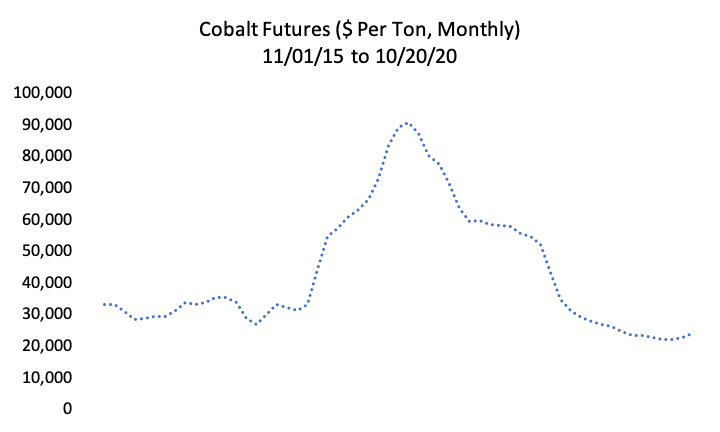
That notwithstanding, decreasing demand from American and European electric vehicle makers like Tesla will have to be matched by a similar downward trend for Chinese car makers who are currently driving a significant portion of the demand for cobalt in Congo. With slowing demand, there could be less of an incentive for mining companies to co-opt underage children into dangerous mining fields in order to keep up with the needs of electric vehicle makers. As the economic fallout from reduced mining activities will surely be devastating for poor individuals and families that depend on cobalt mining in Congo, there could be a compensatory or advocacy role to be played by Tesla in blunting the effects of such a fallout.


Comments