The Tesla Fantasy
Energy, Environment and Electric Cars in Denmark: A Very Brief History
The Danish public is caught up in a Tesla fantasy. Elon Musk’s dream of having all cars powered by electricity plays an outsize role in the local debate on how to combat climate change, and politicians sometimes give the impression that nothing else is needed to solve the problem. The current social-democratic government has pledged to cut emissions by 70 percent before 2030, but insists the transition must not come at any cost to Danish welfare nor imply any reduction of living standards. As a result, politicians put their hopes in technological innovations, electric cars above all. How did it come to this?
The defining moment of Danish energy history is arguably the oil crisis of 1973. Danes’ relentless belief that green technology will solve the climate crisis stems from the last 40 years’ growth of wind energy which was initiated over the course of this decade.
After the Organization of Arab Petroleum Exporting Countries (OAPEC) in 1973 enacted an oil embargo and cut production during the Yom Kippur War against Israel, the price of oil rose dramatically. Denmark was deeply dependent on foreign energy as a small nation-state, and it devastated the economy. The government rationed consumption of oil and gas, lowered speed limits on highways and even instituted ‘car-free’ Sundays where roads became devoid of cars and filled with people. Already then, politicians viewed vehicles as a central component of the solution to problems of energy. The suburban sprawl of previous decades meant that cars had become an integral part of many people’s lives. Attempts to inhibit driving carried high symbolic value and had direct consequences on Danes’ freedom. In the following decade, taxes on car purchases rose to 180 percent of their value - a strong signal that driving should come at a cost.
The oil crisis coincided with ground-breaking intellectual developments in environmental sciences that co-triggered the transition to green energy. A highly influential 1972 report by the Club of Rome, titled The Limits to Growth, made abundantly clear that sources of economic growth were finite. The world could not continue to burn fossil fuels indefinitely and would have to find alternative energy sources. Two years after, in 1974, the English scientist James Lovelock became famous for his ‘Gaia hypothesis’, which strongly contributed to advancing a new perspective on climate change that would only grow since. Already at this point, scientists had been warning of the greenhouse effect for at least two decades.
Soon after the initial response to the oil crisis of 1973, the Danish state launched an ambitious plan to avoid falling into a similar predicament again. The scheme had three goals: to reduce dependency on energy produced abroad, to lower usage of energy and to promote research in renewable energy. With this plan Denmark entered four decades of a determined quest for energy independence. Research in green energy was funded by the state from 1976, the first exports were sold five years later, Danish companies began drilling oil in the North Sea, and from 1984 onwards the government heavily supported wind energy by reducing its price and financing significant parts of wind mill installation. The ambitious projects were strengthened further by subsequent developments in global politics: UN’s 1987 Brundtland Report encouraged countries to invest in sustainable development and green energy projects, the 1992 Earth Summit in Rio de Janeiro put more emphasis on developing alternative sources of energy, and the adoption of the Kyoto Protocol in 1997 entrenched such policies globally.
The oil crisis in parallel with key scientific developments - quintessentially global movements - thus triggered Denmark’s transition towards green energy. It is today one of the leading developers of wind power with companies Orsted and Vestas as international frontrunners. Both have received massive amounts of state support since the 1970s, and Orsted is still partially owned by the Danish state. Today, wind power produces more than 40 percent of Denmark’s electricity consumption. The huge physical constructions have altered the visual (and sometimes auditory) expression of sea and landscape in many parts of the country.
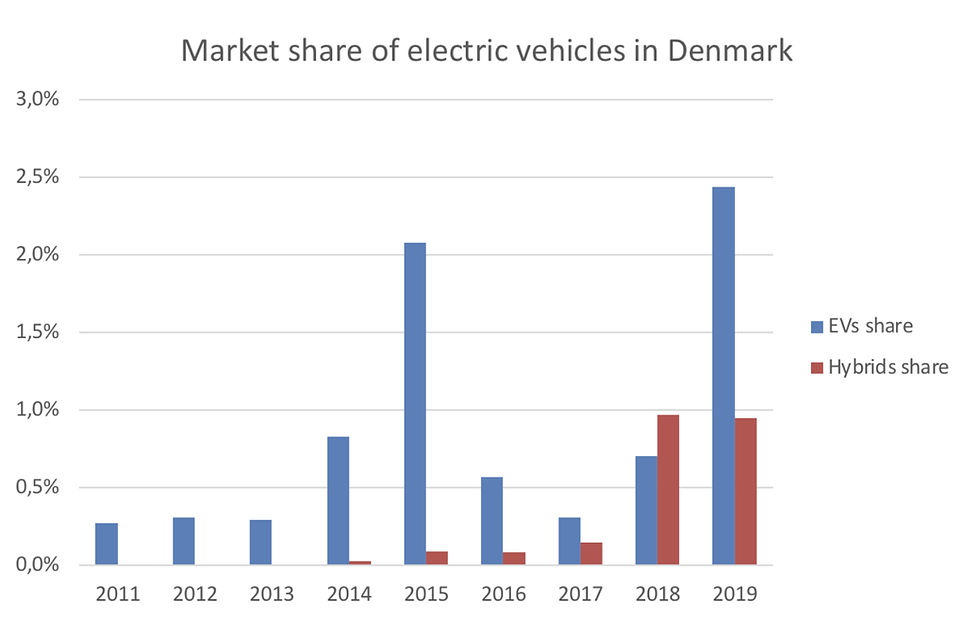
In recent months, the Danish media and public have been caught up in a heated discussion on the politics of electric cars. Hopes of any easy solution were dashed in September. The government established last year a so-called ‘el-car commission’ composed of scientists and former business leaders to give recommendations on how to reform the Danish transport sector. Eagerly awaited, the group published its report in September and claimed it would be very expensive to reach the government's goals of having one million electric cars on the roads by 2030 (out of three million vehicles in total). They pointed to several inhibiting factors: The cost of public infrastructure to charge batteries, the as-of-yet low range of batteries and the relatively high price of such cars. Other ways to reduce emission from driving, such as roadpricing, have been considered repeatedly, but so far have always been denied due to the extra cost it would impose on commuters. Electric cars seem to meet the same political roadblock: It must not harm Danish welfare to save the climate, it is said.
Most importantly - and most devastating for the proponents of electric cars as the prime solution to fossil emissions - recent calculations by scientists show that 500,000 extra electric vehicles in Denmark would only contribute to reducing less than one percent of the emissions required by the government’s 2030 project. Even so, the Tesla fantasy plays an outsize role in the public debate, arguably as something that distracts attention from the real drivers of climate change. In a country where people will be among the last to suffer from global warming, buying a Tesla exudes the symbolic value of contributing to the green transition - as a sort of indulgence meant to excuse other harmful practices. It is grounded in the stubborn belief that technology will solve the crisis we are in, one which breeds passivity in the face of climate change.
Sources (in Danish):
Berlingske (2014, 2020, 2020): https://www.berlingske.dk/privatoekonomi/historien-bag-de-danske-bilafgifter & https://www.berlingske.dk/videnskab/750000-danske-elbiler-redder-ikke-klimaet & https://www.berlingske.dk/oekonomi/eksperter-i-haard-kritik-af-elbilkommissions-beregninger-bliver-ikke-naer
Danmarkshistorien.dk (2019, 2018): https://danmarkshistorien.dk/leksikon-og-kilder/vis/materiale/den-fossile-kultur-og-oliekriserne/ & https://danmarkshistorien.dk/leksikon-og-kilder/vis/materiale/oliekriserne-og-deres-betydning-for-dansk-oekonomi-1973-1991/
Den Store Danske (2017): https://denstoredanske.lex.dk/elbil
Energistyrelsen (2011): https://ens.dk/sites/ens.dk/files/Vindenergi/vindmoelleindustrien_historisk_flagskib.pdf

Comments