Tesla in the Danish Media
Frame #1: Green taxes as a subsidy for luxury cars
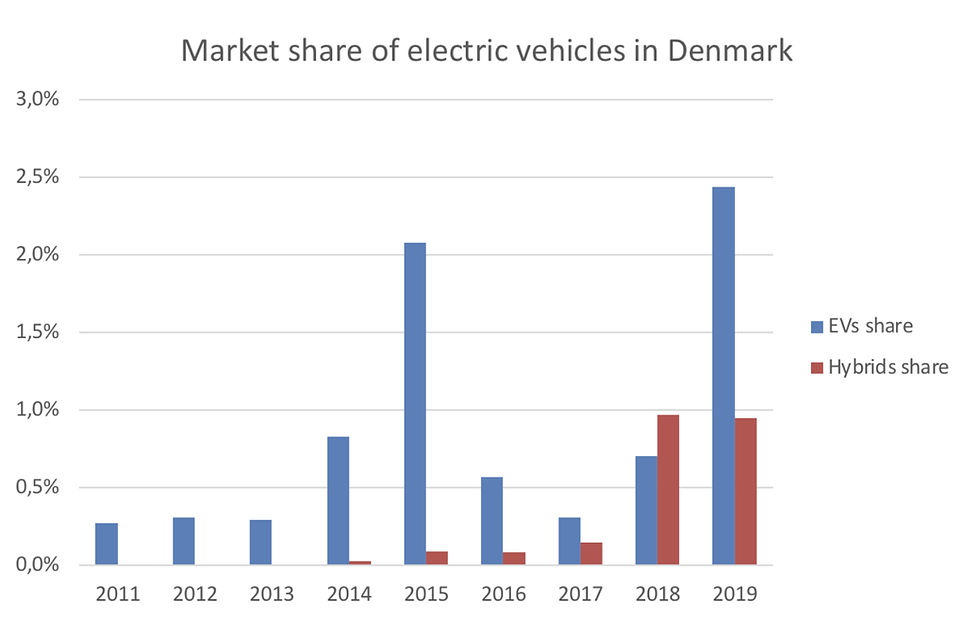
When the Danish government rolled back the favorable tax rules for electric cars in 2015, they were in part motivated to ensure a level playing field in the market. However, they were also eager to put an end to what many viewed as a subsidy (a word that circulates in many articles) for luxury cars and thus the country’s wealthiest citizens. Tesla models were and still are the most sold electric vehicle in Denmark and by far the single brand that most people associate with green cars. Because they are among the most expensive, too, the diminished tax percentage for EVs provided Tesla buyers with the highest absolute price reductions. Many Danes viewed the arrangement as profoundly unfair. This framing of the political discussion on electric cars remains to this day. Tesla’s market dominance in Denmark thereby ensures that it is toxic for politicians - especially on the left wing - to propose reductions of taxes on environmentally friendly cars. The increasing proliferation of cheaper EVs slowly counteracts this dynamic, but an electric car is still viewed as a luxury car for the rich. As the spokesperson for the Forenede Danske Elbilister, a group for EV enthusiasts in Denmark, said last year: “The whole debate on electric cars is complicated by Tesla” (Bernsen 2019). In September, a new government-sponsored report on electric cars likewise “warned against letting regular drivers pay for rich people’s electric vehicles” (Vestergaard 2020a).
Frame #2: “Electric cars need batteries”
“A float of electric cars is a fata morgana without massive investments in the raw materials industry” reads the headline of a recent article in Information (Kalvig and Keiding 2020). “Electric cars need batteries” stated the title of another piece simply in Weekendavisen earlier this year (Vestergaard 2020b). Danish geologists, economists and journalists have become acutely aware of the supply chains behind the Tesla. They increasingly frame electric cars as sites of power (Chinese control of raw materials) and independence (of resources) as well as social and environmental issues. The two articles referenced above showed the following images, one from Congo and the other from China, which represent how images circulate within this framing of the debate. For now, the lack of raw materials and political preparedness of the European Union still dominates the discussions.


Frame #3: Realism
The Danish debate is fundamentally driven by desires for realism. But what seems realistic to one part is naive to the other, and vice versa. To some, the green transition is impossible without reforming the transport sector with electric cars because it is such an important part of the Danish fuel consumption (Møllgaard and Kristensen 2020). Proponents of this view typically describe EVs as necessary but not sufficient. Others think a good balance between economic growth and environmental goals is the only path forward. We must be ‘ambitious, but realistic’ as a leader article titled ‘Green vanity’ recently proclaimed (Krasnik 2020). The highly discussed September report mentioned earlier concluded similarly that a goal of 750,000 green cars in 2030 reflects “the best balance” between the various objectives of the Danish state (Aagaard 2020). Yet others believe the most realistic perspective is to realize that electric cars are not green at all. “No, electric cars aren’t green, they are not sustainable, and they will never be”, wrote a union leader in Politiken a few weeks ago (Burgwald 2020). A similar piece in Information the following week stated that they will never be a solution (Sidenius and Hesdorf 2020). In these cases, the authors argue in favor of more public transportation and a general reduction of the Danish car fleet instead. All of the above claim to be the most realistic and take pride in the realism of their views; it just so happens that their beliefs in what is actually possible differ widely.
Sources
Aagaard, Lars Henrik. 2020. “750.000 danske elbiler redder ikke klimaet”. Berlingske. Accessed October 31, 2020: https://www.berlingske.dk/videnskab/750000-danske-elbiler-redder-ikke-klimaet
Bernsen, Markus. 2019. “110 kilometer i timen i en iPhone”. Weekendavisen. Accessed October 31, 2020: https://www.weekendavisen.dk/2019-48/samfund/110-kilometer-i-timen-i-en-iphone
Burgwald, Reiner. 2020. “Stop misinformationen: Nej, elbiler er ikke grønne, de er ikke bæredygtige, og de bliver det aldrig”. Politiken. Accessed October 31, 2020: https://politiken.dk/debat/debatindlaeg/art7937669/Nej-elbiler-er-ikke-grønne-de-er-ikke-bæredygtige-og-de-bliver-det-aldrig
Kalvig, Per and Keiding, Jakob Kløve. 2020. “En flåde af elbiler er et fatamorgana uden massive investeringer i råstofindustrien”. Information. Accessed October 31, 2020: https://www.information.dk/debat/2020/09/flaade-elbiler-fatamorgana-uden-massive-investeringer-raastofindustrien
Krasnik, Martin. 2020. “Grøn forfængelighed”. Weekendavisen. Accessed October 31, 2020: https://www.weekendavisen.dk/2020-37/samfund/groen-forfaengelighed
Møllgaard, Peter and Kristensen, Niels Buus. 2020. “Uden elbiler når vi ikke klimamålet”. Berlingske. Accessed October 31, 2020: https://www.berlingske.dk/kronikker/uden-elbiler-naar-vi-ikke-klimamaalet
Sidenius, Otto and Hesdorf, Helle. 2020. “Elbiler bliver aldrig løsningen på klimakrisen - brug pengene på grøn offentlig transport”. Information. Accessed October 31, 2020: https://www.information.dk/debat/2020/10/elbiler-aldrig-loesningen-paa-klimakrisen-brug-pengene-paa-groen-offentlig-transport
Vestergaard, Frede. 2020a. “Strid strøm”. Weekendavisen. Accessed October 31, 2020: https://www.weekendavisen.dk/2020-37/samfund/strid-stroem
Vestergaard, Frede. 2020b. “Elbiler behøver batterier”. Weekendavisen. Accessed October 31, 2020: https://www.weekendavisen.dk/2020-11/samfund/elbiler-behoever-batterier
Comments